Tag Archives: Mexico City

Walking Tours of Puebla de Los Angeles

1 May
Download to your phone, tablet, laptop on Amazon.com, Amazon.com.mx; Barnes and Noble.com; Kobo.com (now includes sony Readers) and on Google Play. Search William J. Conaway.

Download to your phone, tablet, laptop on Amazon.com, Amazon.com.mx; Barnes and Noble.com; Kobo.com (now includes sony Readers) and on Google Play. Search William J. Conaway.

An excerpt from my, “Walking Tours of Puebla de Los Angeles.”

Walking Tours of Puebla de los Angeles
Copyright William J. Conaway, 2009

The city of Puebla, capital of the state of the same name, is located in the large, high altitude, Puebla Valley, that connects to the Valle de México, 80 miles southeast of Mexico City. It is one of the oldest Spanish Colonial cities, founded in 1531, on a site not previously occupied. Legend has it that a band of angels appeared to Bishop Julian Garcés pointing to the location of the future city.

Puebla is renown for its distinctive Spanish Colonial architecture, and UNESCO designated it a World Heritage City in 1987. A truly Spanish Colonial city of imposing civil architecture next to centuries old churches. The Spaniards, with the aid of native artisans, left behind a magnificent architectural legacy. A National Monument.

Four volcanoes, the highest peaks in México, are visible, on a clear day, from the city: Popocatépetl (17,883 ft.), Iztaccihuatl (17, 338 ft.), La Malinche (14,632 ft.), and Citlaltépetl or Pico de Orizaba (18,855 ft.). Popo, as it’s affectionately called, is an active volcano occasionally spewing smoke and ash.

The city is officially known today as Puebla de Zaragoza, named for the General Ignacio Zaragoza, who successfully defended the city against the French Imperial Army on May 5, 1862. It is an important link between the Gulf Coast and Mexico City even today. An important agricultural, commercial, and manufacturing center. The population, as determined by the 2000 census, was 1,346,000 souls.

Getting there: Wherever you are go to Mexico City, to the Terminal Norte, and take the ADO bus to Puebla. It’s that easy. Don’t drive. It’s not worth it. Too much traffic, and no place to park. There are hundreds of perfectly adequate hotels, but I recommend the Hotel Colonial. It’s right beside the Church of the Company of Jesus, and one block from the Zócalo.

(Interspersed with the history and the walking tours of the city I have included some of the legends. The legends will be inserted at the place where they occurred, and will appear in italics.)

Puebla’s main Plaza, called the Zócalo, is the cultural, political, religious nucleus of the city and our tours will begin from there. The tree filled Plaza is flanked with beautiful, old colonial buildings, and graced with iron benches and a large fountain. The surrounding streets form a grid pattern adhering to the Spanish Colonial ‘blueprint.” The vivid talavera tile, evident throughout Puebla, was a craft brought here from Talavera de la Reina, a Spanish city near Toledo, Spain, and is produced here to this day.

Here, right on the square you can find a Burger King, a Carl’s Jr., and around the corner a KFC. And all around the place are coffee shops of The Italian Coffee Company. What you won’t find are the usual junk shops for tourists. Puebla’s visitors are mostly here on business. The tourists I did see were mostly European.
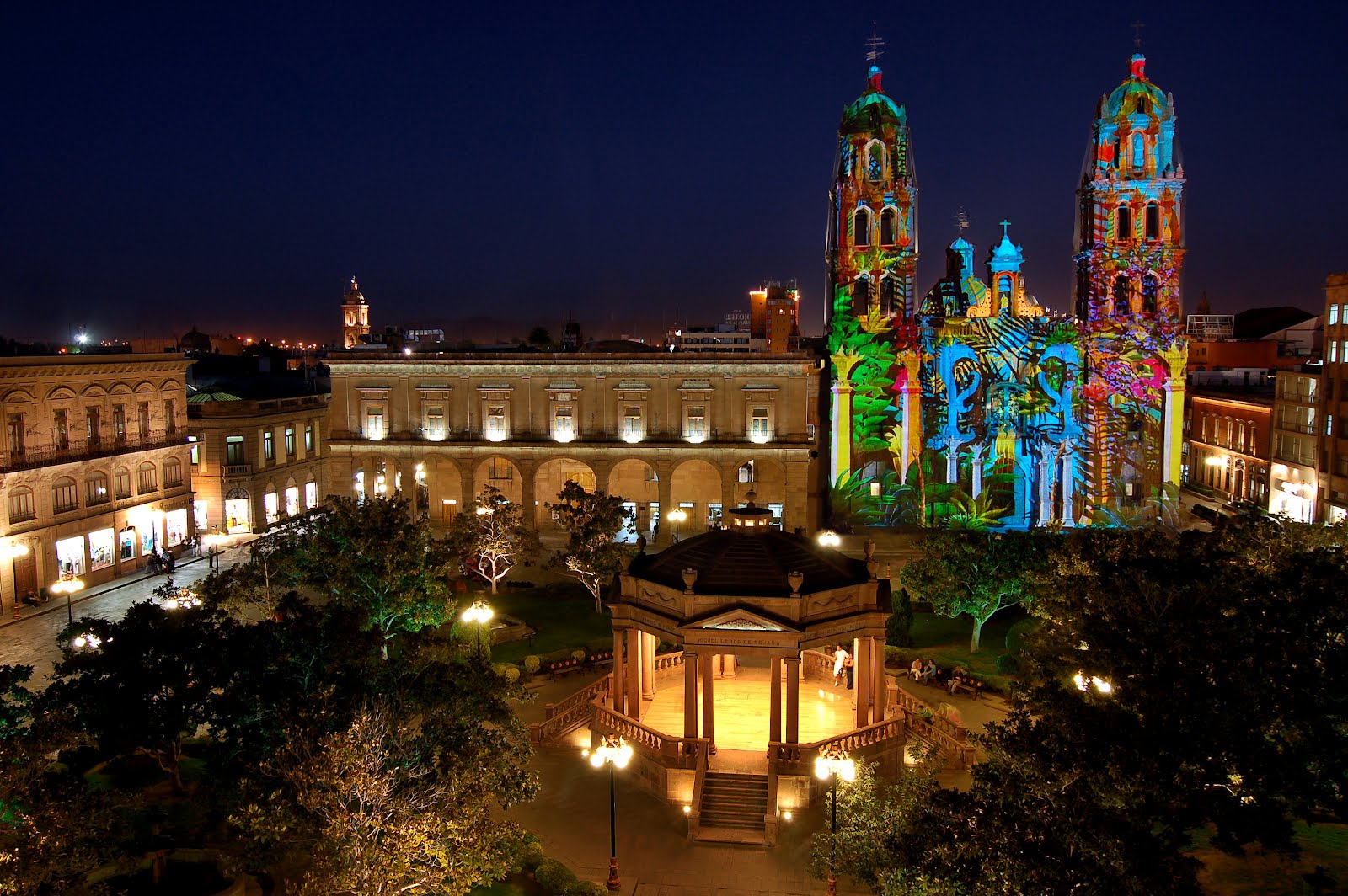
Walking Tours of San Luis Potosí

30 Mar
Download to your phone, tablet, laptop on Amazon.com, Amazon.com.mx; Barnes and Noble.com; Kobo.com (now includes sony Readers) and on Google Play. Search William J. Conaway.

Download to your phone, tablet, laptop on Amazon.com, Amazon.com.mx; Barnes and Noble.com; Kobo.com (now includes sony Readers) and on Google Play. Search William J. Conaway.

Walking Tours of San Luis Potosí
Copyright William J. Conaway, 1999, Derechos Reservados

Getting There
Getting to San Luis Potosí from anywhere is easy. It’s a major industrial city, capital of the State of the Same name, and a university town.

I recommend the first-class busses instead of taking a car because, as usual, there’s no place to park. The walking tours are just that, and where the distances are too great I suggest a cab. For just a few dollars you can get anywhere in the city in minutes.

Hotels are no problem because there’s a jillion of them. Use your Fodor’s. If you’re on a budget there’s plenty of low cost hotels right down in the heart of the Historic center.

Prepare yourself by reading the history of the place first….

La Gran Chichimeca
The Gran Chichimeca is the name given by the Spanish conquistadors to a vast stretch of land north of the settlement of Querétaro. The word Chichimeca comes from the Aztec language and means barbarian. The Aztecs had been unable to conquer these nomadic tribes of hunter-gatherers, and had only begun rudimentary trading with them from their fortified settlement in what is now San Juan del Río.

After the conquest of Tenochtitlán, the Conquistadores built their houses in what is now Mexico City. They rested for awhile, spending their time gambling and carousing, but with each new ship arriving from Spain came more and more men of the same caliber—men looking for adventure, and filled with the desire to make their fortune in the New World.

These soldiers of fortune fanned out northward from Mexico City, at first following the Gulf coast into the lands populated by the more sedentary Indians on the edge of the Gran Chichimeca. These early conquistadors and the accompanying clergy evangelized the Indians they encountered and enlisted them into their armies as allies. This was readily accomplished because these Indians had lived in fear of the Chichimecas their entire lives, with good reason, and by joining the Spanish they were provided with powerful weapons and even horses.

These expeditions gradually moved inland to confront the Chichimecas directly. The Spaniards went, seeking gold and silver, and their Indian allies went along in search of fertile land, under the protection of the King, that had been promised them for their help.

These armies of conquerors followed all the rumors, the legends, the stories, that were related to them by the newly converted Indians they evangelized on their travels. Eventually, in 1546, they discovered the great deposits of silver in Zacatecas. The mines there, hundreds of miles from “civilization,” were totally surrounded by hostile Indians who murdered most of the original settlers and continually attacked those that followed. It became nearly impossible to bring in the much needed supplies, and to take out the rich silver ore that the miners extracted.

The settlement of Querétaro was the last outpost before the vast unsettled lands that made up the Gran Chichimeca. Vast stretches of unpopulated land along the trail known as “El Camino Real de la Plata,” the Royal Silver Trail, aided the Indians in their attacks against the Spaniards.

Father Juan de San Miguel was sent out with converted Tarascan Indians from Acámbaro to build new settlements, and to convert as many Chichimecas as possible.

The first settlement was San Miguel de Los Chichimecas (now de Allende), in 1542. From there Father Juan moved north and east to Xichu where he built another. These settlements, from the very first, suffered sporadic attacks by bands of marauding Indians, who viewed these settlements as encroachments on their territory.